Your analysis results will appear here.
Enter text and click "Detect AI Content" to begin.
Part 1: How the Standard Analysis works
Learn how the Standard Linguistic analysis works and how to check a blog post that we think is human-written.
Part 2: How the Advanced Analysis works
Learn how the Advanced Behavioral analysis works, when to use it, and how to detect AI patterns.
| Analysis Category | Specific Metric | GPT-4o | GPT 5 Mini | Gemini Flash 2.5 | Gemini Pro 2.5 |
|---|---|---|---|---|---|
| Lexical/Sentence-Level | Lexical diversity score | ✅ | ✅ | ✅ | ✅ |
| Sentence length variation | ✅ | ✅ | ✅ | ✅ | |
| Grammatical/Stylistic | Punctuation diversity index | ✅ | ✅ | ✅ | ✅ |
| Grammatical error frequency | ⚠️ | ✅ | ⚠️ | ✅ | |
| Filler word usage | ✅ | ✅ | ✅ | ✅ | |
| Repetitiveness score | ✅ | ✅ | ✅ | ✅ | |
| Complexity score | ✅ | ✅ | ✅ | ✅ | |
| Naturalness Markers | Naturalness score | ✅ | ✅ | ✅ | ✅ |
| Contraction density | ✅ | ✅ | ✅ | ✅ | |
| Colloquialism frequency | ✅ | ✅ | ⚠️ | ✅ | |
| Anaphora usage | ✅ | ✅ | ✅ | ✅ |
Lexical Diversity Score
Measures vocabulary variety. AI text tends to have lower diversity, relying on repetitive, high-frequency words.
Sentence Length Variation
Quantifies fluctuation in sentence length. AI text often shows uniform sentence lengths (e.g., 15–25 words).
Punctuation Diversity Index
Evaluates the variety of punctuation. AI-generated content relies mostly on commas and periods.
Grammatical Error Frequency
Tracks natural errors. AI text typically exhibits near-perfect grammar, which can be a strong indicator.
Filler Word Usage
Measures discourse markers. AI tends to overuse formal transitions like "however" and "thus."
Repetitiveness & Complexity
Evaluates redundant phrases and syntactic sophistication. AI can reuse exact phrases and inflate complexity unnaturally.
Naturalness Score
Rates how human-like the writing feels. AI-generated text is often overly coherent, monotone, and lacks a distinctive "voice."
Contraction & Colloquialism
Tracks informal language. AI tends to use contractions sparingly and rarely uses colloquialisms, sounding overly formal.
Detection Criteria: Standard
Focuses on writing style, grammar, and sentence structure. Good for general use, analyzing metrics like lexical diversity, repetitiveness, and naturalness.
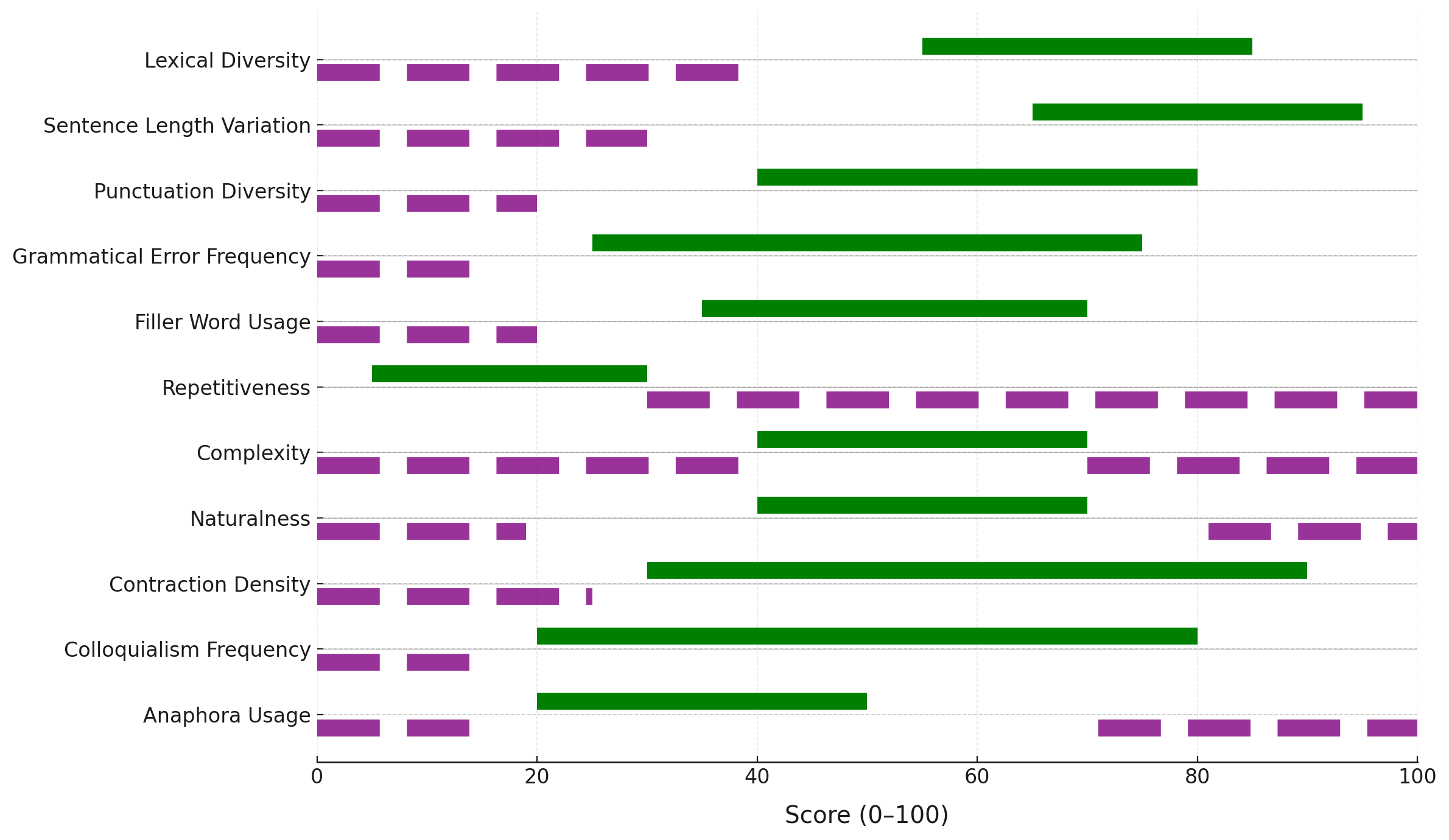
Variable Ranges Visualization
8-Step Calculation Process
- Text Input & Model Selection: User provides text content and selects AI model (GPT-4o, o4-mini, Gemini 2.5 Flash/Pro).
- Initial AI Analysis: Selected model analyzes text and returns scores (0-100) for 11 linguistic metrics plus flagged sentences.
- Initialization: Set base score to 50 (neutral) and detect if text is formal writing (academic/technical keywords).
- Metric-Based Adjustments: Apply credit/penalty system based on human vs AI ranges for each metric. Formal writing exemptions apply to certain metrics.
- AI-like Sentence Density: Calculate percentage of sentences flagged as AI-like. If <8%: credit (-2.5x), if ≥11%: penalty (+2.5x), 8-10%: neutral.
- Confidence-Based Balancing: Calculate confidence from score extremity. If confidence <75, pull score toward neutral (50).
- Final Normalization: Clamp and round final score to integer between 0-100.
- Return Results: Output AI probability, human probability, confidence level, and detailed analysis metrics.